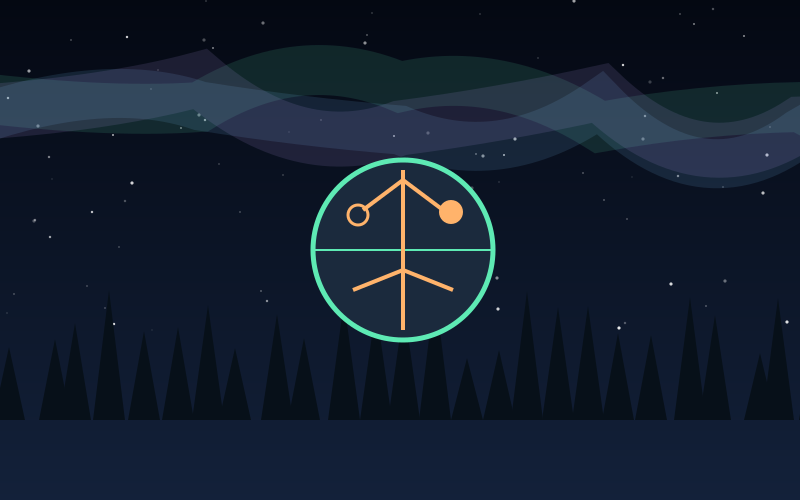
To understand what a Siberian shaman did during a rite, we must first understand how the world in which they moved was imagined. Many cosmologies of Siberia and Central Asia share a basic structure: the universe is divided into stacked levels, linked by an axis. The shaman is the one who knows how to travel along this axis.
A layered structure
In its simplest form, the cosmos consists of three parts:
| Level | Typical inhabitants | Features |
|---|---|---|
| Upper world | celestial deities, luminous spirits | light, order, origin of souls in some traditions |
| Middle world | humans, animals, spirits of places | everyday life, hunting, herding |
| Lower world | ancestors, the dead, dangerous spirits | darkness, but also return and regeneration |
This division should not be taken as a rigid scheme valid everywhere. In many traditions the upper world is itself divided into several heavens, sometimes seven, nine or seventeen, according to versions collected among Turkic and Mongolic peoples. The lower world too may have several levels. The number varies from people to people and even from narrator to narrator.
The axis of the world
What holds these levels together is an axis, which sources describe in different forms. It may be an immense tree, a mountain, a pole, a column holding up the sky, or a river flowing through the worlds. Historians of religion have called this element the axis mundi, the axis of the world.
Among many Siberian peoples the dominant image is the cosmic tree: its roots sink into the lower world, its trunk passes through the middle world, its branches reach the sky. On the branches may dwell souls not yet born, in the form of birds, waiting to descend to earth. Stories of this kind have been recorded among several Siberian peoples.
The Pole Star and the hole in the sky
Another recurring theme is that of the nail of the sky. Among various Turkic and Mongolic peoples the Pole Star was seen as a stake or nail around which the vault of heaven turns. In some traditions the sky has an opening, a hole, through which one can pass from one level to another.
This image has a concrete counterpart in the dwelling. In the tent of nomadic peoples, the smoke hole at the centre of the roof corresponds symbolically to the hole in the sky, and the central pole or the rising smoke indicates the way upwards. The home thus becomes a small cosmos, with the hearth at its centre.
The river of the worlds
Among some taiga peoples, such as the Evenki, the image of a cosmic river appears alongside the tree: its sources lie in the upper world, its mouth in the lower world, and the middle world lies along its course. The shaman can travel up or down the river, and his or her helper spirits guard the stretches of the route.
This river cosmology reflects the real landscape of peoples who lived along the great Siberian rivers. The cosmos was not a distant abstraction, but a transfiguration of known territory.
The shaman's journey
Ritual activity is built on this structure. During the session, the shaman makes a journey to the upper or lower world, depending on the purpose. One ascended to bring offerings and requests to the celestial deities; one descended to accompany the dead, to search for a soul believed to be lost, to negotiate with hostile spirits.
Ethnographic descriptions show that this journey was often performed theatrically: the shaman mimed the ascent, described the obstacles aloud and spoke with the spirits encountered. Those present followed the story and took part with responses and songs.
The tree in the rite
The cosmic tree did not remain merely a mental image. In many ceremonies it was made visible: a birch planted at the centre of the ritual space, a notched pole, a real tree in the forest chosen as a sacred place. Climbing the tree, or symbolically going up its steps, meant rising from heaven to heaven.
A key to interpretation
Many readers will recognise in these images motifs found elsewhere too: the ash Yggdrasill of Norse tradition, the cosmic mountain of other cultures, the ladder joining heaven and earth. Comparative study has brought these analogies to light, but it is important not to confuse similarity with identity. Each people built its own image of the cosmos from its own landscape, economy and history.
In short
- Many Siberian cosmologies divide the universe into upper, middle and lower worlds.
- The levels are joined by an axis: tree, mountain, pole, river or Pole Star.
- The nomadic tent reproduces the cosmos, with the smoke hole as an opening to the sky.
- The shaman travels along the axis upwards or downwards, depending on the purpose of the rite.
- Analogies with other cultures are real, but each cosmology remains tied to its people.