
In the far north of Europe, across Norway, Sweden, Finland and the Kola Peninsula, live the Sami, who call their land Sápmi. Before Christianisation was completed, between the 17th and 18th centuries, the Sami had a religious figure whom scholars compare without hesitation to the Siberian shamans: the noaidi. His best-known instrument was the drum, one of the most studied objects in all of European ethnography.
Who the noaidi was
The noaidi was the specialist who maintained relations between the community and the invisible world. The sources, almost all written by missionaries and officials, attribute some recurring tasks to him:
- consulting the spirits to learn the outcome of a hunt, a journey or a reindeer migration;
- intervening when a person was thought to suffer from soul loss or a hostile influence;
- accompanying sacrifices to the powers of the landscape;
- making ritual journeys, in a state of trance, to the realms of spirits and the dead.
In 17th-century descriptions the noaidi falls to the ground as if lifeless while his «spirit» travels; those present, often women, sing to support him and call him back. It is a pattern found, with variations, throughout the circumpolar area.
The drum and its figures
The Sami drum, called goavddis in North Sami and by other names in other Sami languages, consisted of a wooden frame over which a reindeer hide was stretched. On the hide numerous figures were painted with a reddish dye made from alder bark: deities, people, reindeer, dwellings, boats, the sun, sometimes churches and Christian figures.
There were different construction types, varying by region:
| Type | Main feature |
|---|---|
| Frame drum | hide stretched over a bent wooden ring |
| Bowl drum | body carved from a single piece of wood, with decorative openings |
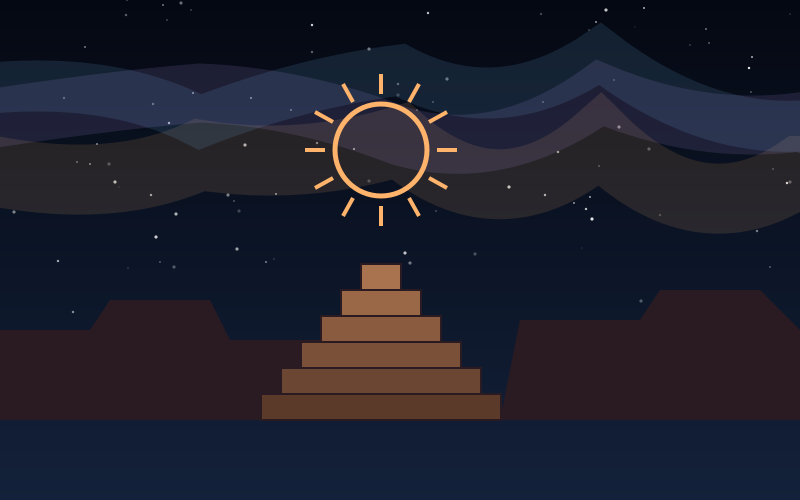
The figures were not decoration. They formed a true map of the cosmos, often divided into horizontal bands corresponding to the levels of the world: the sky with its powers, the land of humans, the underworld of the dead. The sun sometimes occupied the centre, sometimes a prominent position.
The pointer and divination
One function of the drum was divinatory. A small pointer was placed on the hide, often a ring or a cluster of metal rings, or a piece of bone or antler. As the drum was struck with an antler hammer, the pointer moved across the surface and came to rest on one figure or another. Its path gave indications about the question asked.
This use was not reserved for the noaidi alone: according to some sources heads of households also owned a drum for domestic consultations. The noaidi, however, also used it as the vehicle of trance and journeying.
The divine figures
Among the painted figures, missionaries recognised some recurring powers, whose names have come down to us in various spellings. Among the best known:
- Madderakka, the ancestral mother linked to birth, and her daughters Sarakka, Juksakka and Uksakka, associated with childbirth, the destiny of the unborn child and the threshold of the tent;
- a thunder power, often depicted with a hammer;
- the sun, in many variants;
- figures of the world of the dead, placed in the lower part of the drum.
The female figures of the household show how closely Sami religion was interwoven with the daily life of the tent and the family.
The persecution
From the 17th century the state authorities and the Lutheran Churches of Sweden and Denmark-Norway undertook a systematic campaign against Sami religion. Drums were sought out, confiscated and burned; sacred places were desecrated; noaidi were put on trial. In Norway the missionary Thomas von Westen, at the beginning of the 18th century, was one of the central figures of this effort.
A well-known case is that of Anders Poulsen, an elderly noaidi tried at Vadsø in 1692, who during his interrogation explained the meaning of the figures on his drum. He was killed before the verdict. His drum ended up in the Danish royal collections and, after a long Sami request, was returned to a Sami museum in Norway in 2023.
Paradoxically, many drums survived precisely because they were confiscated and sent to the collections of Copenhagen, Stockholm and other European cities. A few dozen remain, each different from the others.
The drum today
For many contemporary Sami the drum has become a symbol of identity and cultural continuity. Artists and craftspeople build new ones, inspired by historical models. The debate over the return of drums held in museums is part of a wider process of recognising Sami history.
Studio Esoterico Cornelio looks at these objects with the respect due to a living tradition: not as exotic curiosities, but as testimonies of a way of inhabiting the world.
In short
- The noaidi was the religious specialist of the Sami, compared by scholars to the Siberian shamans.
- The drum, with its painted figures, was a map of the cosmos and a divinatory instrument.
- A pointer moving across the struck hide provided answers to questions.
- In the 17th and 18th centuries Church and State persecuted noaidi and drums.
- Today the drum is a symbol of identity and the focus of requests for restitution.