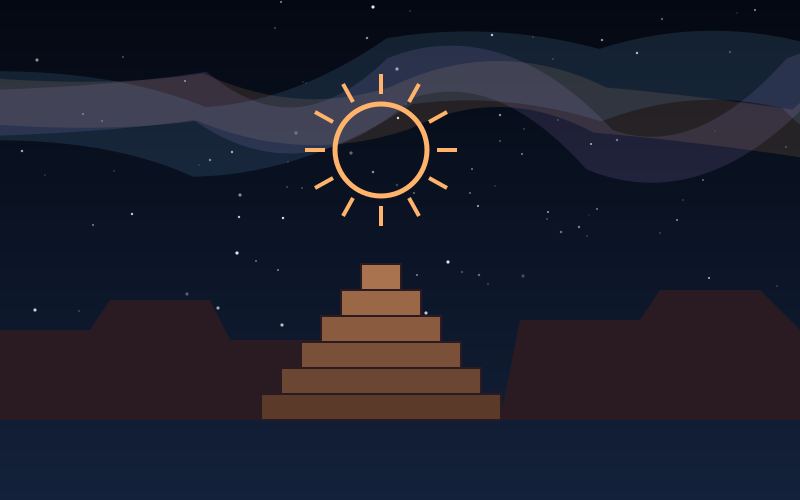

In western Tibet, far from the great cities, rises a mountain of singular shape: an almost regular pyramid covered in snow, with its faces turned toward the cardinal points. It is Kailash, which Tibetans call Gang Rinpoche, "jewel of the snows". Few places in the world are sacred to so many traditions at once: Bön, Buddhism, Hinduism and Jainism all recognise in it the centre of their cosmos.
The centre of the Bön world
For Bön, Kailash is Yungdrung Gutseg, the "mountain of nine stacked yungdrungs". The region around it was the heart of Zhang Zhung, the western kingdom from which the Bön tradition derives its history. According to Bön texts, the founder Tonpa Shenrab descended onto this very mountain when he came to Tibet.
The sacred geography of Bön places meditation sites, caves of ancient masters and shrines around Kailash. For the Bönpo, the pilgrimage around the mountain is made anticlockwise, with the mountain on one's left.
The mountain of the Buddhists
For Tibetan Buddhists, Kailash is the abode of Chakrasamvara, a tantric deity of primary importance, and of his consort. Many traditions also identify it with Mount Meru, the axis of the universe in Indian cosmology.
A famous story tells of the contest between the yogi Milarepa, Tibet's poet-saint, and a Bön master named Naro Bönchung. The two competed for the mountain with marvels, until Milarepa reached the summit first at dawn, riding a ray of sunlight. The tale, born in Buddhist circles, expresses the passing of the place under Buddhist authority, but it also acknowledges the ancient presence of Bön.
Shiva, Rishabha and the sacred waters
For Hindus, Kailash is the abode of Shiva, who sits there in meditation with his wife Parvati. The name itself, Kailāsa, is Sanskrit and appears in epic literature and the Puranas. In the region rise, or are traditionally placed, the sources of great rivers such as the Indus, the Sutlej, the Brahmaputra and a branch feeding the Ganges.
For Jains, the mountain is Ashtapada, the place where the first of the tirthankaras, Rishabhanatha, attained final liberation.
At the foot of the mountain lie two lakes of opposite meaning:
- Manasarovar (Mapham Yumtso in Tibetan), a freshwater lake considered utterly pure and a destination for ritual bathing;
- Rakshastal (Langak Tso), brackish, associated in Hindu tradition with the demon Ravana and perceived as a "dark" lake.
The kora: walking around the centre
The pilgrims' fundamental gesture is not climbing but going around. The Kailash kora is a circuit of about fifty kilometres, reaching very high altitudes and its highest point at the Dolma La pass, above five thousand metres. Many pilgrims walk it in three days, some in a single day; the most devout complete it with full prostrations, measuring the path with their own bodies.
Along the route there are stages rich in meaning:
- the place where pilgrims leave a garment or a lock of hair, a sign of symbolic death to their former life;
- footprints and caves attributed to saints and masters;
- cairns and prayer flags marking the passes;
- the descent toward the valleys, experienced as a renewed return.
A kora is believed to purify the faults of a lifetime, and a large number of circuits to bring great merit. The Horse year in the Tibetan cycle is considered especially auspicious.
An unviolated summit
Kailash is not climbed out of respect: its summit belongs to the gods. This prohibition, respected by the international mountaineering community, says a great deal about how the cultures of the plateau understand the sacred mountain: not a trophy to be conquered, but a centre around which to order one's life.
The symbol of the centre
Kailash is an almost perfect example of what historians of religion call the axis of the world: the point where sky, earth and underworlds touch. The pilgrim who walks around it does with the feet what the meditator does with the mind: return to the centre.
In short
- Kailash is sacred to Bön, Buddhism, Hinduism and Jainism.
- For Bön it is Yungdrung Gutseg, heart of ancient Zhang Zhung, and the kora is made anticlockwise.
- The legend of Milarepa and Naro Bönchung tells of the mountain passing to Buddhism.
- Lakes Manasarovar and Rakshastal have opposite symbolic meanings.
- The mountain is not climbed: it is walked around, on a circuit of about fifty kilometres.