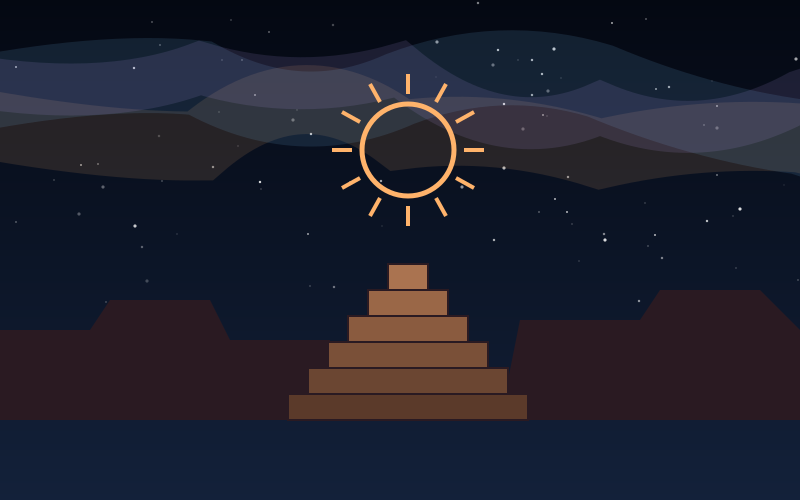
The Andean tradition holds a coherent and refined vision of the cosmos, expressed in the Quechua language, in myths recorded in colonial times and in the still-living practices of the communities. At its heart is the idea that the world is made of different levels in constant relationship, and that balance arises from the meeting of complementary forces. Knowing its main concepts helps in reading many aspects of Andean culture, from architecture to textiles.
Pacha: space and time together
The word pacha is the key to everything. It means earth, world, but also time and age. In Quechua, space and time are not separate: a place is also a moment, and an age is also a way the world exists. This is why the same word forms both the names of the worlds and the concept of historical upheaval.
The three worlds
The Andean worldview distinguishes three main levels:
- Hanan pacha, the world above: the sky, the sun, the moon, the stars, the higher powers.
- Kay pacha, «this world»: the surface of the earth where human beings, animals and plants live.
- Ukhu pacha (or uku pacha), the world below or within: the inside of the earth, springs, caves, the place of the ancestors and of seeds.
It is important not to read these worlds through the Christian categories of heaven and hell, even though Spanish missionaries translated them exactly that way. The ukhu pacha is not a place of punishment: it is the womb from which life is born, the place from which spring water and shoots emerge. Many origin myths tell that the ancestors of peoples emerged from lakes, caves or rocks, that is, from the inner world.
In the interpretation widespread today, each world is associated with an animal: the condor with hanan pacha, the puma with kay pacha, the serpent with ukhu pacha. It is a modern reading that draws on images found in Andean art and became established mainly in the twentieth century.
Yanantin: complementary duality
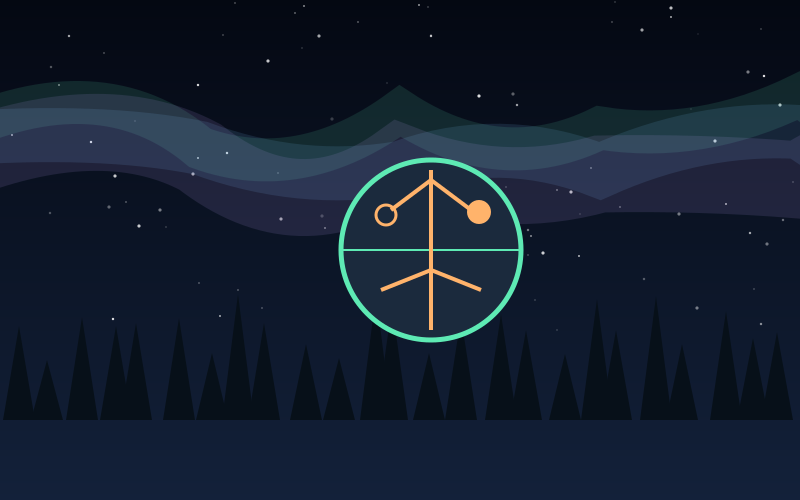
Another fundamental concept is yanantin, the pair of opposite and complementary elements that together form a whole. Male and female, right and left, high and low, sun and moon are not enemies, but halves that complete each other.
This logic is found in social organisation. Many Andean communities, and Inca Cusco itself, were divided into two halves: hanan, «upper», and hurin, «lower». Each half had its own leaders and ritual functions, and only their union formed the complete community.
Alongside yanantin one often hears of tinkuy, the meeting of the two halves: a moment of contact, sometimes even of ritual clash, from which a new balance arises.
Pachakuti: the overturning of the world
The word pachakuti means «overturning of the world» or «return of time». It refers to a radical change in which the previous order is turned upside down and a new one is born. It was also the name of one of the greatest Inca rulers, Pachacútec, to whom tradition credits the transformation of Cusco into an imperial capital.
In Andean thought history does not move in a straight line, but passes through ages separated by these great overturnings. After the Spanish conquest, some Andean texts and movements interpreted the arrival of the Europeans as a pachakuti, and awaited a new overturning that would restore the ancient order.
The chakana, the Andean cross
The chakana is a stepped cross, with four equal arms and often a circle at the centre. The stepped motif is very old in the Andes: it appears in the art of Tiwanaku, in textiles, ceramics and in the architecture of various pre-Hispanic cultures.
The name and the meaning attributed to it today are largely the result of modern interpretations. It is often said that chakana means «bridge» or «ladder», that is, what links the worlds, and that the cross represents the constellation of the Southern Cross. In the second half of the twentieth century the chakana was loaded with many meanings: the four directions, the three worlds, Andean ethical principles. It has become a strong symbol of contemporary Andean identity.
Those who study it seriously therefore distinguish between the ancient motif, certain and documented, and the later symbolic readings, legitimate as the expression of a living culture, but not always attested in ancient sources.
In short
- Pacha means space and time together: world and age.
- Hanan, kay and ukhu pacha are the worlds above, here and below, all necessary for life.
- The ukhu pacha is not a hell, but the womb from which water, seeds and ancestors emerge.
- Yanantin expresses complementary duality, also visible in the hanan and hurin halves.
- The chakana is an ancient motif; many of its symbolic interpretations are modern.